University of Southampton
Chan Zheng Lin (30102669)
2nd November 2018
Introduction
According to Hooke’s law, Robert Hooke, who discovered this law(1600) defines the explanation which of the amount of force needed to stretch or compress a spring by a certain amount of distance scales in 1676. It is also known with the equation invented by him which is, F=kx where F is force (in Newton), k is the spring constant (Newton per meter) that brings the meaning of the stiffness of a spring, and x which is the amount of distance changed (in meter) compared to the origin length of the spring.

http://molekulerbiyolojivegenetik.org/robert-hooke/
From his discovery that a spring has also a limitation to its capability to change its length after applying some vast amount of force upon it. This situation occurs when we encounter that the spring lost its ability to change back to its original length from the extension that has exceeded its spring constant. Which we call plastic deformation, an object tend to not fix its length back to its normal shape once the force applied on it overreach its spring constant.
Based on his law, an object such as a spring has different kind of spring constant which only can uphold its own capability of sustaining a certain amount of force. And this has to be dealt with the various types of springs that depends on its length, diameter, types of material made of (either more elastic or less elastic), and thickness, too. These are the factors that varies their spring constant and the stiffness of a spring.
Theory
The displacement or the portion of deformation made is directly proportional to the force applied on a spring.
.The higher the force or load, the more of deformation occurs.
F=kx
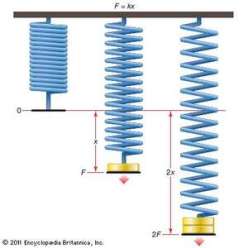
https://www.britannica.com/science/Hookes-law
Figure 1: Shows the expansion, x changes according to the force or load, F applied.
Based on the formula of Hooke’s law, F=kx, where F is force or load applies, x is the changes from the normal to the deformation, and k is the spring constant. With F and x as constants, we can easily calculate the spring constant of the spring by doing simple mathematics.
As for the relative changes that determines the spring constant is depends on the thickness of the spring, diameter of the spring, material made of the spring, length of the spring, and the number of turns of the spring.
Experiment of Hooke’s Law (Methods)
I have conducted out an experiment which my data given is as below:
x = 1.00, 2.00, 3.00, 4.00, 5.00, 6.00, 7.00, 8.00, 9.00
y1 = 3.00, 4.50, 6.00, 7.50, 9.00, 10.50, 13.00, 14.00, 15.00
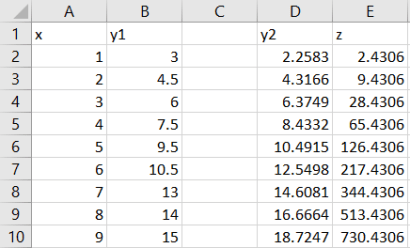 (Table 1)
As you can see from the table above, I have used Microsoft Excel to carry out the whole calculations.
y2=(1.5583+0.5)*A2+0.2 ~ [for the 1st one (rest is followed by A3:A10)]
z=A2^3+1.4306 ~ [for the 1st one (rest is followed by A3:A10)]
As I used the data from above to form a y1, which represents Spring 1 and y2, represents Spring 2 against x graph. The diagram is shown as below:
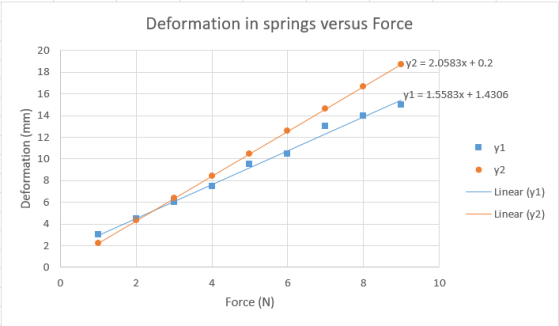 (Graph 1)
The graph is obtained by importing the data from the x value and y1 value for Spring 1 (blue linear line) and Spring 2 (orange linear line) is conducted from the data x value and y2 value. And in the graph for the linear line y1 against x, I inserted the equation which shows the value of the gradient and the y-intercept which are 1.5583 and 1.4306 respectively.
As for the equation of y1=ax+b, the value of a and b can be equivalent to the value gotten from the equation line.
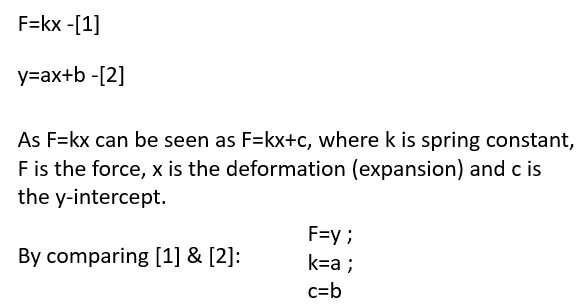
In result, a=1.5583, gradient representing the stiffness of the spring and b=1.4306.
For the values of y2 which I can found from the equation y2=(a+b)x+c after substituting all the value got from the equation before, where c=0.2.
y2=(1.5583+0.5)*[A2:A10]+0.2
Then the values of y2 and x is imported into the graph which got me the orange linear line. As in the graph, there is an interception between the two lines which is at the same amount of 4.5mm and 4.3166mm value of deformation from the 2 equations above.
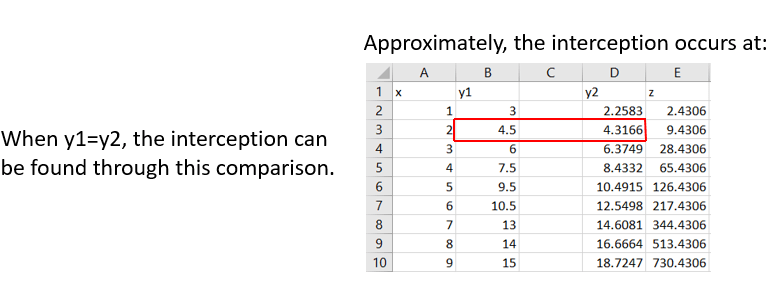
Then the interception can be gotten by getting the average of both of the y value which is:
Interception of y1 and y2: (4.5+4.3166)/2=4.4083
This shows that the two different elastic materials achieved the same amount of deformation which is when they have achieved 4.4083mm of elestic deformation value.
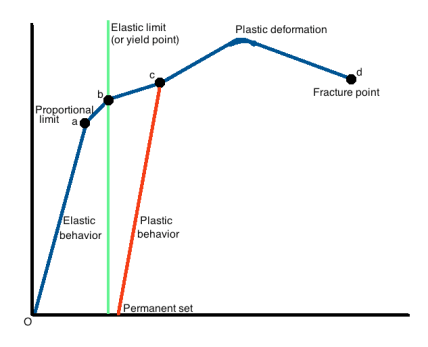 Figure 2: Plastic Deformation Graph
http://teenskepchick.org/2013/10/14/the-physics-philes-lesson-69-hookes-law-line-and-sinker
Graph 2 shows that wh/en the value of force applied upon the materials increased, the extension on the spring caused by the stretching or compressing will be increased directly proportional with the force. But when the force has overreached the capability of the materials to sustain the force, another phenomena will occurred. That is to be called plastic deformation.
Which as when I keep on going the experiment, I conducted a z=x^3+b equation where I sub the force, x values from before into this equation. This equation indicates the value of plastic deformation for the material. When the material exceeded the value of z with a larger amount of force, the material will be deformed and never turns back to normal shape.
The graph below shows the graph of plastic deformation against force.
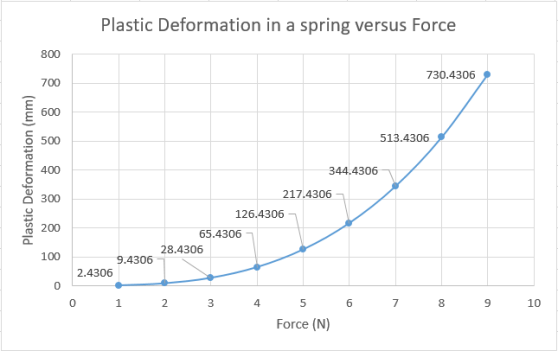 (Graph 2)
As you can see that when the force, x value is increasing the value of z is also increasing together with the force. The higher it goes, easier it is for a material to be deformed. Based on the Hooke’s law, various types of material has different value of spring constant which makes them carry different level of stiffness. When their spring constant are low, they tend to deform with just a minute value of plastic deformation, z with a little amount of force.
In Graph 2 we can see that when the force applied is increased, the value of plastic deformation will also increase which carries much more possibility for the material to be deformed. Moreover, in Hooke’s law, when the force applied to the material has further exceeded the value of plastic deformation, the material will eventually break apart, which means it is literally cannot be fixed to the original shape, evidently.
As in for the conclusion, Hooke’s law is all about the ability of a material to be stretched or compressed by a certain amount of force, the length of the material will changed directly proportional with the force. However, plastic deformation will occur as when the force reached the plastic deformation of the material where the shape of the material is unable to change back to its original form. Further extend of force will only break the bonds between the atoms of the material and eventually it breaks apart. The hypothesis of Hooke’s law is accepted. Additionally, Hooke’s law can also be expressed in terms of stress and strain where the same phenomenon occurrence happens.
Results and Discussion
- Interpret from the graphs above, the springs are increasing along with the force or load applied on them.
- From graph 1, the results shows that the spring constant for Spring 2 (blue one) is lower than Spring 1 based one the steepness of the gradient. where as in graph 2, it shows that the deformation of the spring is slowly increasing along with the forces applied.
- The data shown in graph may have some error which one of them is it does not starts from the 0 point. Additionally, there is a point where it is far away from the best fit line in y1 (blue line) while the data given should show less uncertainty percentage from the best fit line.
Conclusion
In conclusion, the result succeed in showing that the spring constant is directly proportional to the force or load applied. If it was experimental, the data should give us results with uncertainty percentage where universal phenomenon can not be avoided. For instances, parallax error from human reaction when measuring the reading. This can be minimized by repeating the measurement of the reading to achieve the accuracy of the results.
Reference
- The Editors of Encyclopaedia Britannica, (2017), “Hooke’s law”. [online] Encyclopaedia Britannica. Available at: https://www.britannica.com/science/Hookes-law
- Wikipedia, (2018), “Hooke’s law”. [online] Wikipedia. Available at: https://en.wikipedia.org/wiki/Hooke%27s_law

 David_Chan777